
How to Choose an LED Shop Display for Commercial Projects: From Display Requirements to Installation Planning

1. Start with the Project Requirements, Not Just the Screen
In retail stores, shopping malls, brand stores, and commercial spaces, LED shop displays can present product information, promotional messages, brand content, and dynamic advertising. Selecting a display for a commercial project involves more than choosing an attractive screen. Installation space, viewing distance, content format, screen construction, and future maintenance all influence the final configuration.
A narrow storefront window, for example, may be better suited to a bar-shaped display. A space that needs to show full video content may require a different screen format and viewing area. Before comparing models, clarify three things: where the display will be installed, how far away viewers will stand, and whether the main content will be text, images, or video.
2. Why Consider a Bar-Shaped LED Shop Display?
Not every commercial space has room for a conventional rectangular LED screen. Storefront windows, the areas above display cabinets, and narrow wall sections may offer useful display space without accommodating a standard screen format.
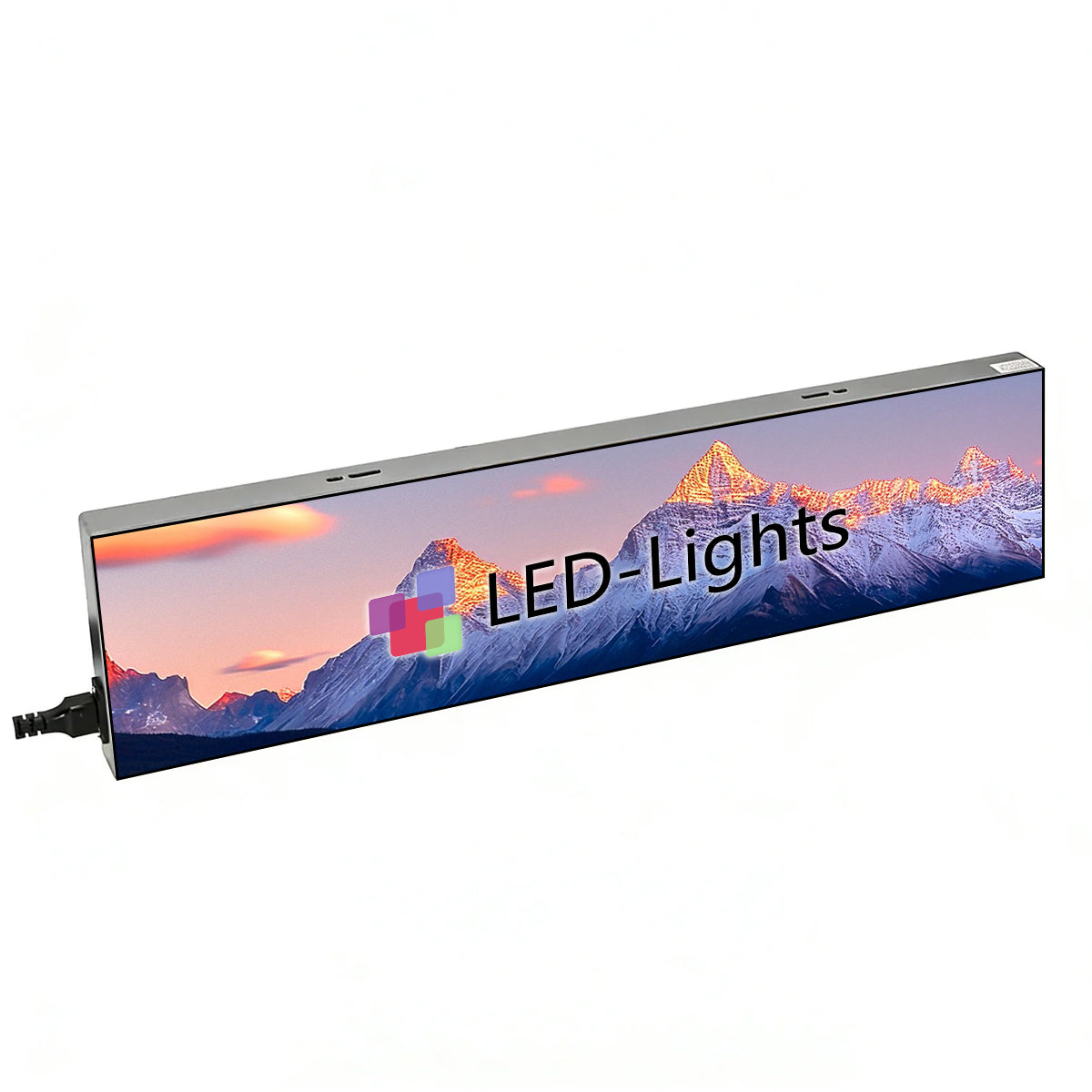
A bar-shaped LED shop display provides another option. Its long, narrow format can be considered for horizontal or vertical layouts, depending on the product design and site conditions. It can present scrolling messages, product information, promotions, and brand content in spaces that might otherwise remain unused.
| Installation Location | Possible Display Content | Planning Considerations |
|---|---|---|
| Retail storefront | Brand messages and promotions | Window dimensions and viewing angle |
| Product display area | Product names and short information | Mounting height and readability |
| Shopping mall entrance | Store name and campaign messages | Screen length and viewing distance |
| Restaurant or café | Menu highlights and promotions | Content layout and font size |
| Commercial showroom | Product introductions and brand content | Screen position and overall layout |
3. Measure the Installation Area Before Selecting a Model
A practical project should begin with the site, not with a product dimension chosen in isolation. Measure the available width and height, check the distance to window frames and nearby fixtures, and identify anything that could obstruct the screen or its mounting points. Also leave room for inspection and maintenance.
Horizontal layout can suit wide, low-height spaces and content such as scrolling messages or brand slogans. Vertical layout may make better use of narrow wall sections or the sides of an entrance. The suitable orientation depends on the display's physical design, mounting method, and the way the content will be created.
Before finalizing the layout, compare the screen's actual dimensions with the measured installation area. Do not assume that every model can be rotated or mounted in every direction.
4. Match Pixel Pitch to Viewing Distance and Content
Pixel pitch is the distance between adjacent pixels, usually measured in millimeters. Under otherwise comparable conditions, a smaller pixel pitch provides a higher pixel density within the same display area and can help show finer details at closer viewing distances.
However, the smallest available pixel pitch is not automatically the best choice for every project. If viewers stand farther away and the screen mainly displays short messages or simple promotional content, the project may not benefit enough from a finer pitch to justify the additional cost.
| Project Condition | What to Evaluate |
|---|---|
| Close viewing distance | Pixel pitch and text detail |
| Viewing from outside a storefront | Brightness, viewing angle, and ambient light |
| Scrolling text | Font size, message length, and layout |
| Images or video | Screen proportions, resolution, and content fit |
| Limited screen dimensions | Effective display area and pixel count |
The LL collection currently lists LFL-S shop displays with a P1.86 pixel pitch. Whether this specification suits a particular site should be judged against its viewing distance, content, and installation dimensions.
5. Consider the Display Construction: Frameless Design and GOB Surface Protection
Screen construction can matter in retail environments where the display is part of the interior presentation. The LL collection describes its LFL-S series as frameless and identifies GOB surface protection on the relevant model.
Frameless design reduces the visual presence of a conventional border and can help the display sit more neatly within a modern storefront or retail interior. It is still important to check the actual housing dimensions and mounting arrangement before planning the installation.
GOB (Glue on Board) is a surface-protection process used on LED modules. It adds a protective layer over the LED surface. Treat this as a construction feature, not as proof that the display is waterproof or suitable for outdoor exposure. Confirm the protection rating and permitted environment in the exact model's specification before use.
6. Plan Power, Signal, Ventilation, and Maintenance
A display may fit the available space and still create problems if the supporting installation has not been planned. Before ordering, review the electrical and site requirements alongside the screen dimensions.
| Project Check | What to Confirm |
|---|---|
| Mounting structure | Whether the wall, frame, or support can accommodate the display and its mounting hardware |
| Power supply | Input requirements, power connection, and available electrical supply |
| Signal and control | Supported input, control method, and compatibility with the planned playback equipment |
| Ventilation | Whether the installation leaves the cooling space required by the product |
| Cable routing | Whether power and signal cables can be routed safely and neatly |
| Maintenance access | Whether the display can be inspected or serviced after installation |
| Content layout | Whether text, images, and video are designed for the screen's proportions |
For projects with multiple displays, plan the power and signal routes as part of the overall layout. Follow the model-specific installation instructions rather than assuming that all shop displays share the same connection or mounting requirements.
7. Prepare the Project Information Before Requesting a Quote
Providing clear project information helps the supplier assess the application and identify which product details need to be confirmed. It also reduces repeated questions during the quotation process.
| Information to Prepare | Details to Provide |
|---|---|
| Application | Storefront, shopping mall, restaurant, or showroom |
| Installation dimensions | Available width, height, and site photos |
| Orientation | Horizontal or vertical, subject to model support |
| Viewing distance | Typical distance between viewers and the screen |
| Display content | Text, images, video, or a combination |
| Display specification | Preferred pixel pitch and clarity requirements |
| Quantity | Single unit or multiple displays |
| Project requirements | Mounting, power, control, delivery, and installation considerations |
For unusual dimensions or installation conditions, confirm whether the selected model supports the required arrangement. Do not assume that every product can be resized or customized.
Project Review: Check These Items Before Ordering
- Screen dimensions match the measured installation space.
- Pixel pitch is appropriate for the viewing distance and content.
- Content is designed for the display's proportions.
- Product construction and surface protection suit the intended environment.
- Power and signal requirements have been confirmed.
- Mounting, ventilation, cable routing, and maintenance access have been reviewed.
- The selected model's specifications and included accessories have been checked.
LED Shop Display Collection at LED-Lights.com
The LL collection currently features the LFL-S frameless LED shop display series, including P1.86 models in different length configurations. Review the current product listings and confirm the exact dimensions, construction, mounting method, and electrical specifications for the model you are considering.
Explore the LED Shop Display Collection at LED-Lights.com
LED-Lights.com – Practical LED Display Solutions for Commercial Projects.